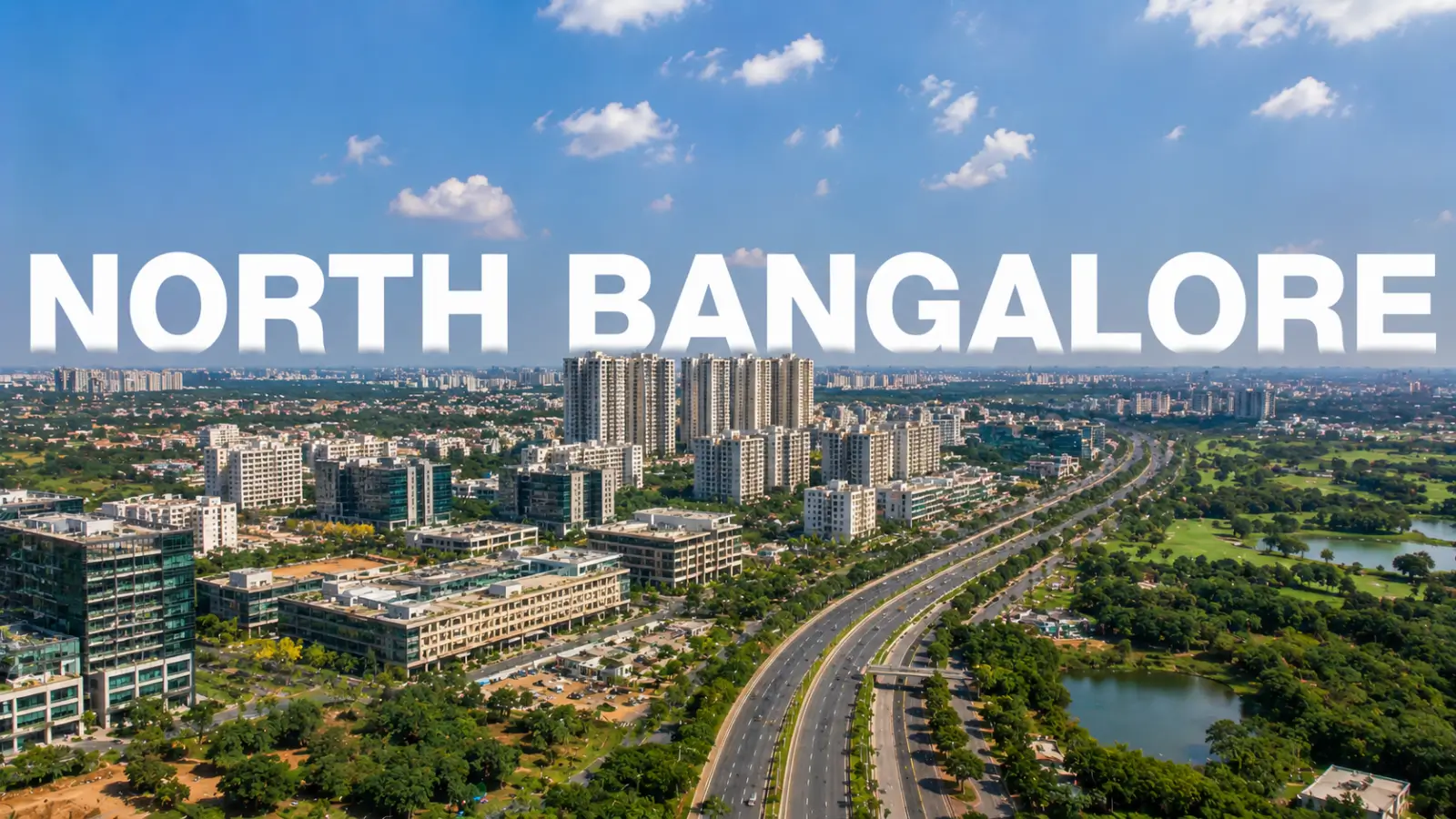
A North Bangalore real estate market forecast for 2026 — price trends, demand drivers and the growth zones to watch, read honestly with the risks. Explore the.
A forecast is a way of organising what we know, not a claim to predict the future. This North Bangalore real estate market forecast 2026 trends overview pulls together the demand drivers, the price outlook, and the growth zones, with its uncertainty stated rather than hidden. We have kept the optimism grounded and the risks visible, so the picture is useful for a decision rather than a sales line. For the appreciation record beneath the outlook, our capital appreciation trends piece sets the base.
The 2026 Backdrop
North Bangalore enters the year as the city’s most active growth axis. A general property market analysis North Bangalore supports points to the same foundations — the airport, the metro, the expressway, and a deepening base of employment — continuing to pull demand northwards, against a supply of large, well-located luxury inventory that remains limited. That balance of firm demand and constrained quality supply is the backdrop against which prices are set, and it has underpinned the corridor’s recent strength.
The Demand Drivers
Demand here rests on tangible foundations rather than sentiment. The airport anchors the region; the Blue Line metro and the Airport Expressway tighten access; the KIADB Aerospace Park, the Devanahalli Business Park, and adjacent technology and commercial space build employment; and the international schools and healthcare arriving make the area liveable for families. Each driver feeds the others — jobs draw residents, residents draw amenities, amenities draw more residents — and together they form the engine our North Bangalore growth corridor piece describes. Demand built on this many pillars is steadier than demand resting on one.
The Luxury Segment
Within the market, the premium end has its own dynamics. The luxury apartment demand forecast Sadahalli and the wider belt support rests on a particular buyer — professionals, business owners, NRIs, and frequent flyers drawn to space, brand, and airport access — and on the scarcity of large, low-density estates that can serve them. Luxury moves differently from mid-market housing: thinner volumes, more discerning buyers, and pricing tied to scale, design, and developer pedigree. Where a project offers genuine differentiation at a sensible entry price, demand in this segment has held firm.
The Growth Zones to Watch
Not every pocket will perform alike, and location within the corridor matters. The question of which areas in North Bangalore will appreciate most tends to favour the pockets that pair real connectivity with room to grow — the airport-approach belt around Devanahalli and Sadahalli, the established premium of Hebbal, and the stretches closest to confirmed metro stations and major employment. Sadahalli’s claim rests on sitting tight against the airport and the Expressway with a Blue Line station nearby, at pricing still below the city. As always, the specific project within a pocket matters as much as the pocket itself.
The Price Outlook, Read Honestly
A forecast earns trust by stating its range and its assumptions. The base-case outlook for the belt sits near 10 to 12 percent a year, with estimates of up to 15 to 25 percent through the window in which the metro is commissioning and its benefit is priced in. These are projections that assume infrastructure progresses on a reasonable timeline and demand holds; they are not commitments. The sensible reading leans on the base case, treats the upper range as conditional on the drivers actually landing, and tests any purchase against the lower end rather than the headline.
How to Use This Forecast
A forecast earns its keep when it shapes a decision rather than decorates one. The sensible way to use this North Bangalore real estate market forecast 2026 trends overview is to scenario-plan: take the base case as your working assumption, treat the upper range as conditional on the metro and the employment actually landing on time, and stress-test any purchase against the lower end so a slower year would not undo your plan. Tie the horizon to the asset — the corridor’s case is a multi-year one, and a forecast for a single year matters far less than the direction over the period you intend to hold. Revisit the picture as the drivers move: a metro milestone met, an office occupied, or a supply wave launched all shift the odds, and a view held loosely and updated often beats one fixed at the point of purchase. It also pays to separate what a forecast can and cannot tell you — it can frame a plausible range and the forces behind it, but it cannot time the market precisely or guarantee a specific project’s path, since individual developments vary around any average. Hold the number lightly, weight the fundamentals heavily, and let the outlook inform the decision rather than make it.
The Risks
Every outlook carries conditions worth naming. Infrastructure timelines can slip; a large pipeline of new supply could temper growth in a given year; broader economic or interest-rate shifts affect demand; and an emerging area can see uneven, project-specific performance. Luxury liquidity is thinner than mid-market, so exit timing matters more. None of these unseats the corridor’s case, but each is a reason to enter on a multi-year horizon. Our advisory team can share current data, and our commercial real estate growth piece covers the office-led side of demand.
Related reading: What Low-Density Living Really Does for Daily Life.
FAQs
What is the outlook for North Bangalore property in 2026? Demand looks set to stay firm on the back of the airport, metro, expressway and employment, against limited quality supply, with a base-case price outlook near 10 to 12 percent a year.
What is driving demand in the area? The airport, the Blue Line metro, the Airport Expressway, growing employment clusters, and arriving schools and healthcare, which reinforce one another.
Which North Bangalore areas may appreciate most? Pockets pairing real connectivity with room to grow — the Devanahalli and Sadahalli airport belt, established Hebbal, and areas near confirmed metro stations and major employment.
How is the luxury segment expected to perform? It rests on discerning buyers and scarce large estates. Where a project offers genuine differentiation at a sensible entry price, demand has held firm.
How much could prices rise? A base case near 10 to 12 percent a year, with up to 15 to 25 percent estimated through the metro-commissioning window. These are projections, not guarantees.
What are the risks to the forecast? Slipping infrastructure timelines, a large supply pipeline, economic and rate shifts, uneven project-level performance, and thinner luxury liquidity.
Continue Reading
For the record beneath the outlook, read our capital appreciation trends piece, and for the forces behind it, our North Bangalore growth corridor guide. The office-led side sits in our commercial real estate growth piece.
For the full project picture, visit the home page. For current market data, contact our advisory team.
Related Articles

Lodha Sadahalli Reviews: How to Judge a Pre-Launch Project
Lodha Sadahalli reviews and expert opinions in 2026 — what you can assess at the pre-launch stage, how to read early feedback, and how to form an honest view.

Lodha Sadahalli Launch and EOI: How Booking Works
The Lodha Sadahalli EOI and launch date for 2026 — where the project is in its cycle, how the EOI works, the booking process, and what to confirm. Read on

Lodha Sadahalli Cost Sheet: Full Pricing by Configuration
The Lodha Sadahalli cost sheet for 2026 — a detailed breakdown of prices by configuration, the per-sft rate, and the charges beyond the base price. Read on

Lodha Sadahalli RERA Status: Where the Approvals Stand
The Lodha Sadahalli RERA approval status and timeline — where registration stands, what it confirms, the planning position, and what to check before booking.