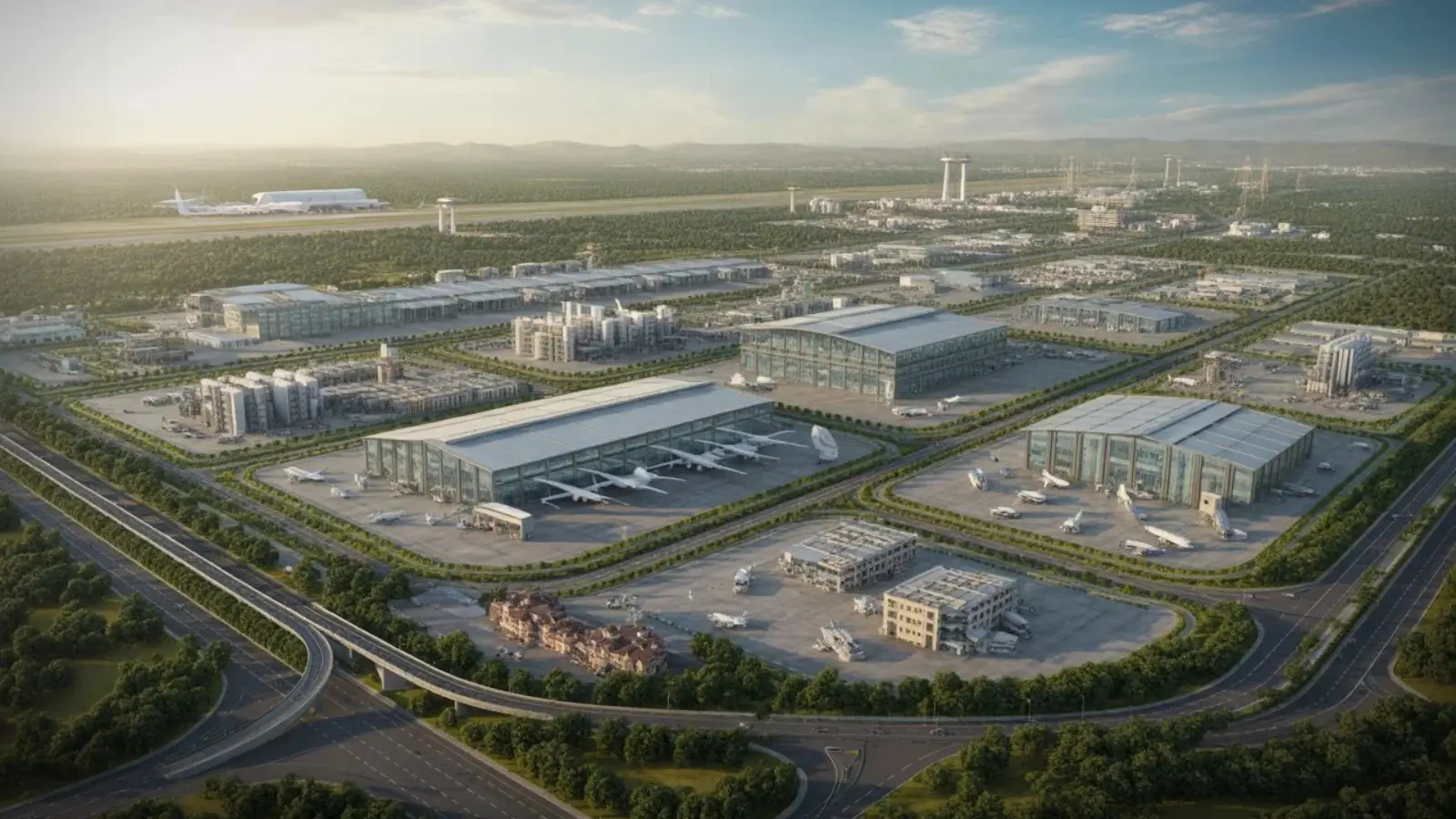
How KIADB Aerospace SEZ employment is shaping housing demand near Sadahalli — the jobs, the defence-aerospace corridor and what it means for homes. Read the.
Not all of North Bangalore’s job growth is in software; a good deal of it is in aerospace and defence. The way KIADB Aerospace SEZ employment impact housing demand Sadahalli plays out follows the same logic as any employment cluster — jobs arrive, workers want homes nearby, and demand follows them — but with the durability that high-skill industrial employment tends to bring. We have set out the cluster, how its jobs become housing demand, and the caveats. For the software side of the same story, our IT corridor expansion piece is the companion read.
The Aerospace SEZ Nearby
The cluster sits close enough to matter for daily life. The KIADB Aerospace Park lies around 6 km from the estate, part of the special economic zone built around the airport to host aerospace, defence, and precision-engineering activity. Its proximity is the point: the aerospace park residential demand Sadahalli North Bangalore generates comes precisely because the work is within a short commute, putting homes here within reach of the people the zone employs. A major industrial cluster on the doorstep is a different proposition from one across the city.
The Jobs It Creates
The employment here has a particular character. Aerospace and defence work tends to be high-skill and relatively stable, spanning engineering, manufacturing, maintenance, and the supplier businesses that grow up around an industrial zone. The SEZ job creation driving apartment sales on this belt is therefore weighted towards well-paid, settled professionals who buy rather than only rent, and whose roles are less prone to the rapid churn of some other sectors. That profile tends to support steady, owner-occupied housing demand rather than purely transient rental demand.
How the Jobs Become Housing Demand
The path from payroll to property is consistent. As the zone fills, a share of its workforce chooses to live within an easy commute, lifting demand first for rentals and then for purchases, while the supplier firms and services that cluster around it add a second wave of employment and demand. A large, well-located residential estate nearby is positioned to serve both. The mechanism is the same one our IT corridor expansion piece describes for software, and the two sources of demand reinforce each other across the belt.
The Defence and Aerospace Corridor
The single zone sits within a bigger story. The defence aerospace corridor Bangalore real estate watchers track reflects a sustained national push into aerospace and defence manufacturing, of which the area around the airport is a part. A long-horizon, policy-backed industry tends to anchor an area’s prospects more durably than a single company or a single cycle, because the investment and the jobs are committed over many years. Our dedicated piece on the KIADB aerospace and defence corridor explores that wider significance.
What It Means for Sadahalli Homes
For a buyer, the aerospace cluster strengthens the demand case in a particular way. It diversifies the employment base beyond IT, adds a pool of stable, high-skill buyers within a short commute, and ties part of the area’s fortunes to a long-horizon national industry rather than a single sector’s cycle. That diversity makes the housing demand behind the area sturdier, which over time supports both rents and prices. It is one more pillar under the corridor rather than the whole structure, but a solid one.
How This Fits the Wider Demand Picture
The aerospace cluster is best read as one strand in a larger weave. On its own, the KIADB Aerospace SEZ employment impact housing demand Sadahalli describes is meaningful; set alongside the IT offices, the commercial space, and the supplier businesses arriving on the belt, it becomes part of a diversified base that is sturdier than any single sector could provide. That diversity is the point — when demand rests on aerospace, software, and commercial employment together, a slowdown in one is cushioned by the others, which makes the housing demand behind the area more resilient over a long hold. The aerospace and defence element adds something further: because it is tied to a long-horizon, policy-backed national push, it tends to commit investment and jobs over many years rather than a single cycle. For a buyer, the takeaway is not that any one cluster guarantees an outcome, but that several real sources of employment, pulling in the same direction, build a more dependable foundation for demand than a single headline ever could. It also reframes how to read the inevitable ups and downs — a quiet stretch in hiring at one cluster need not unsettle the whole picture when others are still growing, and a single large announcement is one input among many rather than a turning point on its own.
The Honest Caveats
Industrial employment is durable, not instant or certain. Zones fill over years, hiring depends on national policy and global cycles, and the gap between an SEZ expanding and its full effect on housing can be long. Aerospace and defence also move with government priorities and budgets, which carry their own uncertainty. As with any single driver, proximity to the cluster is one factor among several — the developer, the price, and the product still decide a specific purchase. Read it as a sturdy, slow-acting tailwind, and our advisory team can discuss how it applies to your decision.
Related reading: How Smart-Home Features Are Reshaping Luxury Living.
FAQs
How close is the aerospace SEZ to Lodha Sadahalli? The KIADB Aerospace Park is around 6 km from the estate, part of the special economic zone built around the airport for aerospace, defence, and precision engineering.
How does the aerospace SEZ affect housing demand? As the zone fills, a share of its high-skill workforce chooses to live within an easy commute, lifting demand for nearby homes to rent and then to buy, with supplier firms adding more.
What kind of jobs does it create? High-skill, relatively stable roles across engineering, manufacturing, maintenance, and the supplier businesses around an industrial zone — a profile weighted towards buyers.
Why does the defence-aerospace angle matter? A long-horizon, policy-backed industry anchors an area’s prospects more durably than a single company or cycle, because the investment and jobs are committed over many years.
Does this guarantee higher prices? No. Zones fill over years and depend on policy and global cycles, so treat it as a sturdy, slow-acting tailwind rather than a certainty, alongside other factors.
Is the area reliant on aerospace alone? No. Aerospace and defence diversify a base that also includes IT and commercial employment, which together make housing demand sturdier than any single sector.
Continue Reading
For the software side of the demand story, read our IT corridor expansion piece, and for the wider significance of the corridor, our KIADB aerospace and defence corridor analysis. The infrastructure around it sits in our upcoming infrastructure guide.
For the full area map, see the location page. To discuss how employment supports your purchase, contact our advisory team.
Related Articles

Lodha Sadahalli Reviews: How to Judge a Pre-Launch Project
Lodha Sadahalli reviews and expert opinions in 2026 — what you can assess at the pre-launch stage, how to read early feedback, and how to form an honest view.

Lodha Sadahalli Launch and EOI: How Booking Works
The Lodha Sadahalli EOI and launch date for 2026 — where the project is in its cycle, how the EOI works, the booking process, and what to confirm. Read on

Lodha Sadahalli Cost Sheet: Full Pricing by Configuration
The Lodha Sadahalli cost sheet for 2026 — a detailed breakdown of prices by configuration, the per-sft rate, and the charges beyond the base price. Read on

Lodha Sadahalli RERA Status: Where the Approvals Stand
The Lodha Sadahalli RERA approval status and timeline — where registration stands, what it confirms, the planning position, and what to check before booking.